

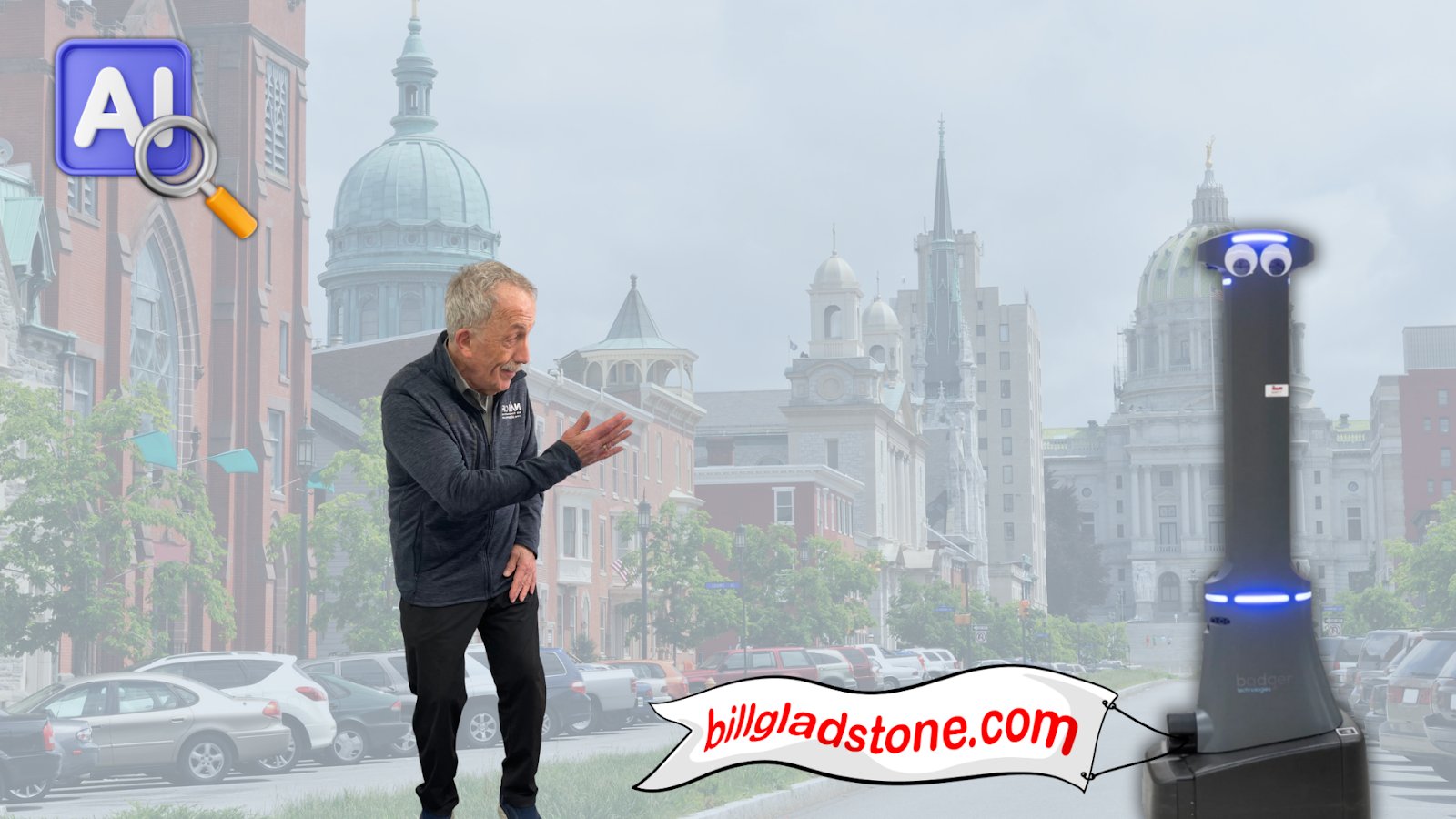
If you’ve been to The Giant Grocery Store recently, you may have seen Marty — the tall, friendly, googly-eyed robot that cruises the aisles scanning for spills and safety issues. During a recent team lunch, Bill Gladstone crossed paths with Marty, and it sparked an unexpected but timely conversation: technology isn’t something that’s “coming one day.” It’s already here — quietly shaping everyday environments we’ve used for decades.
Commercial real estate is experiencing the same kind of shift. Artificial intelligence (AI), building automation, digital workflow tools, and data-driven property management practices are already influencing how spaces are designed, valued, leased, and used.
But, just like Marty, technology is not replacing people.
It’s enhancing the way we work, collaborate, and experience space.
For broader context on long-term CRE evolution, see:
→ The Future of Commercial Real Estate: Local Insights from Global Shifts
1. AI Has Moved From Buzzword to Practical Tool
AI is no longer a trend to watch — it’s becoming a foundational layer in commercial property operations.
According to a recent report from JLL, 89% of real estate executives believe AI will help solve key operational challenges in the industry: https://www.jll.com/en-us/insights/artificial-intelligence-and-its-implications-for-real-estate
This includes:
- Predictive maintenance for building systems
- Automated lease abstraction and documentation
- Data-driven site selection and valuation modeling
- Real-time building operations insights
Technology doesn’t make brokers or property owners less necessary — it makes their decisions smarter.
2. Demand Is Increasing for Tech-Enabled and Flexible Space
As business demands shift and AI-driven industries expand, organizations increasingly need properties that enable data connectivity, hybrid collaboration, and operational versatility.
This is driving interest in:
- Flexible office layouts
- Light-industrial and modern warehouse assets
- Properties prepared for advanced connectivity and automation
For example, banks recently financed a $2B expansion of a new AI-driven data center campus, signaling long-term infrastructure demand: https://www.wsj.com/real-estate/banks-loan-2-billion-to-build-a-100-acre-ai-data-center-in-utah-ca5e7e0d
Here in Central Pennsylvania, proximity to major interstate corridors and distribution networks continues to make the region desirable for logistics, industrial use, and operational HQs.
For more local insight, see:
→ 5 Reasons to Buy Commercial Real Estate in the Greater Harrisburg PA Area
3. Tenants Are Evaluating Space Differently Than Before
When touring properties, tenants today are asking questions that were rare a decade ago:
- How strong is the fiber and internet infrastructure?
- Can HVAC, lighting, and security systems be automated?
Does the building support hybrid work needs? - Can the space adapt if the business grows or shifts?
This reflects broader workplace expectations that evolved during the hybrid-work movement:
→ The Quiet Revolution: Transforming Office Spaces Post-Pandemic
Technology also plays a growing role during negotiations.
→ How to Successfully Negotiate a Commercial Lease: Tips for Tenants and Landlords
4. Tech Upgrades Can Meaningfully Increase Property Value
For property owners and investors, technology offers measurable upside:
- Reduced maintenance and operating costs
- Longer system lifespan
- Lower tenant turnover
- Stronger competitive positioning
- Improved tenant satisfaction
Predictive building systems alert owners to maintenance needs before failures occur — helping protect asset performance and supporting stronger NOI.
For long-term investment planning:
→ Future-Proofing Your Real Estate Portfolio: Strategies for Long-Term Success
5. What This Means for the Greater Harrisburg Region
Central PA continues to be well-positioned for growth due to:
- Transportation connectivity
- Stable workforce
- Competitive land and space costs
- Municipal development activity
The Pennsylvania Department of Community & Economic Development tracks business growth, investment programs, and regional incentives: https://dced.pa.gov
The Bottom Line
Just like Marty the robot quietly navigating the aisles at The Giant Grocery Store, technology in commercial real estate is visible, helpful, and steadily becoming standard.
It doesn’t replace people — it supports them.
It doesn’t remove the need for local expertise — it makes that expertise more valuable.
At The Bill Gladstone Group, we help clients understand how these trends apply right here in Central Pennsylvania, ensuring decisions are informed, strategic, and aligned with future opportunity.